
Ever feel stuck, like all those hours lifting weights aren’t making you any faster on the field? You’re not alone. I’ve seen it happen time and again.
Many athletes build impressive gym strength yet struggle to see it translate into real-world performance.
What’s missing? Fast movement and momentum. After years of analyzing what separates the good from the great, I know it’s not just about muscle.
It’s about athlete drills training that truly boost speed, power, and agility.
I’m here to share exercises that bridge that gap. This isn’t just theory; it’s a guide born from experience. Trust me, you’ll find actionable takeaways here.
By the end, you’ll know exactly which sports performance exercises can raise your game beyond just lifting weights. Ready to boost your athleticism?
Performance vs. Fitness: The Real Game Changer
When we talk about athlete drills training, it’s all about movement patterns, not just pumping iron. You ever notice how a car engine is nothing without a good transmission? Muscles are the engine, but the nervous system and movement patterns are the transmission.
Without them, you’re just revving in place.
Athletic performance is about generating power and momentum. It’s not about isolating a muscle. It’s about using the stretch-shortening cycle and force transfer.
Imagine a rubber band being stretched and released. That’s the stretch-shortening cycle. It helps you jump higher or run faster by storing energy in muscles and tendons, then releasing it explosively.
Force transfer? It’s about directing that energy efficiently. You want all that effort to go into your sprint, not just bounce around your body.
This approach sets the stage for more effective training. Curious about designing a balanced training regimen? It’s key to mastering this.
So, are you training to look good or to perform? Because there’s a big difference. Real athletes focus on what truly matters: movement efficiency.
The Foundation: 3 Exercises for Explosive Power & Speed
Want to leave your competition in the dust? Let’s tap into some raw power and speed with these exercises. These aren’t just any workouts.
They’re game-changers. Feel that adrenaline rush as you leap higher and sprint faster. We’re talking about athlete drills training at its best.
First up, Box Jumps. Get ready to spring like a cat. Start with a sturdy, stable box.
Stand with feet shoulder-width apart. Bend your knees, swing your arms back, and explode upward. Land softly, with a full hip extension.
Why bother? Because Box Jumps teach your muscles to react and contract fast. It’s all about explosive power and those quick-twitch fibers.
Next, Broad Jumps. These aren’t about finesse; they’re about distance. Stand with feet together, swing arms, and leap forward as far as you can.
Land softly. This one boosts your acceleration and that key first-step quickness. Imagine darting past defenders in a flash.
That’s what Broad Jumps do.
Now, the Medicine Ball Slams. Grab a heavy ball, lift it overhead, and slam it down with all your might. Feel that power surging through you.
This move isn’t just for stress relief (though it helps). It’s a full-body workout. Teaching your body to channel force from the ground, through the core, and into the upper body.
Important for sports needing rotational power, like baseball or tennis.
Feeling pumped yet? These exercises aren’t just drills; they’re your foundation for becoming a better athlete. Start today.
Unleash that power.
Unlocking Agility: Drills for Lightning Moves
Momentum moments. You know, those key instants when an athlete stops, starts, and darts in a split second. That’s the edge you want.
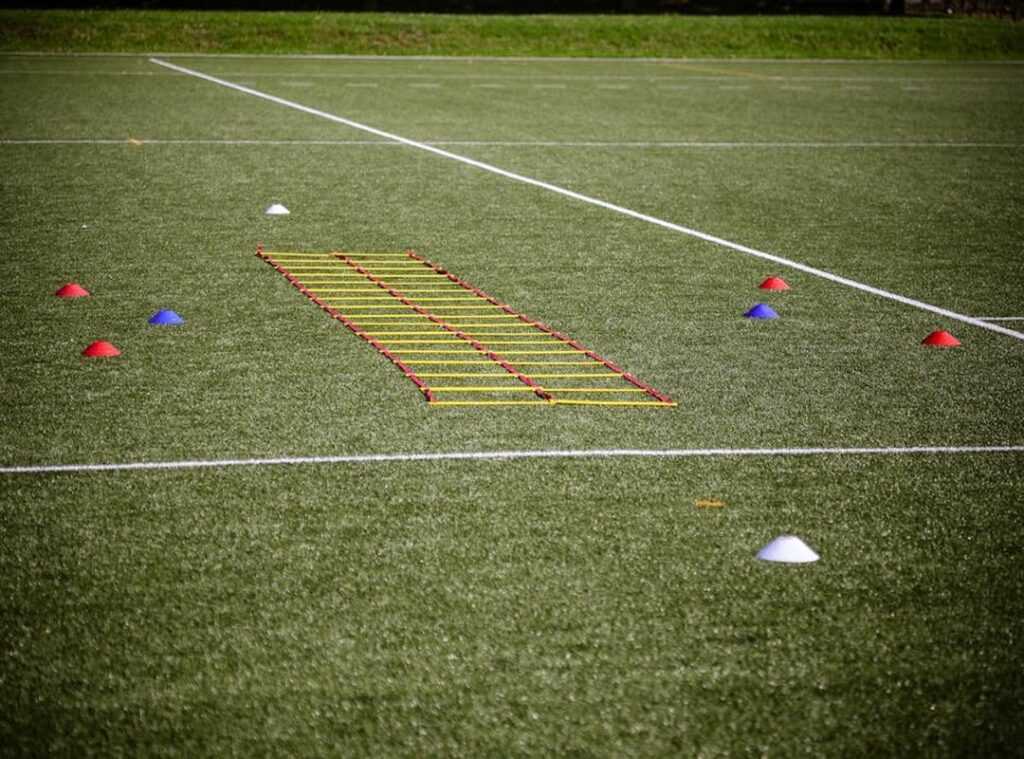
The 5-10-5 Drill is where we start. Ever heard of it? Sometimes called the Pro Agility Drill, it’s the gold standard for measuring change-of-direction speed. You set up three cones in a straight line, five yards apart. Sprint to the first cone, then to the third, and back to the middle. Simple? Sure. But the challenge lies in how fast you can shift gears.
Let’s talk about some drills that can get you there.
Next up, those Lateral Bounds. Picture this: you’re leaping from side to side, like a basketball player defending the hoop. This drill builds hip stability and lateral power, key for those sharp defensive cuts.
And trust me, it’s not just for the pros. Anyone can benefit from that sort of agility.
The T-Drill is another classic. Set up cones in a T-shape. Sprint forward, shuffle side-to-side, then backpedal to the start.
It’s all about combining movements, much like what you’d face in real games. This drill tests your ability to switch directions quickly while keeping control (something) every athlete should master.
What’s the common thread? These drills hone your ability to react and move with purpose. That’s why they’re important in cross training benefits athletes.
Ever tried them? You’ll notice the difference (quickly.) Momentum is everything. Let’s get moving!
The Hidden Engine: Core Exercises for Total Body Control
When people talk about core exercises, they often think it’s all about getting ripped abs. But it’s more than that. The core is like this hidden engine that stabilizes your spine and transfers energy through your body.

It’s the central link that powers everything you do.
Let’s dive into some exercises that build this powerhouse. First up, the Pallof Press. You might be wondering, what’s this about?
Well, it’s an anti-rotation exercise. Picture using a cable machine or resistance band. The goal?
Resist the pull. This strengthens the core by fighting against rotation, forcing you to stay stable. It seems simple, but it’s effective.
Next, Farmer’s Walks. It sounds like a stroll in the countryside, but it’s tougher than it sounds. Grab heavy weights and walk.
That’s it. But the benefits are huge (grip) strength, core stability, even posture. Imagine carrying those hefty grocery bags.
Now, just do it with a plan.
Finally, there’s the Dead Bug. Strange name, right? But it’s gold for core control without stressing your low back.
Lie on your back, extend one arm while lowering the opposite leg. It’s all about control and coordination. Trust me, it’s a safe choice for building strength.
Want to spice up your routine? Check out the top 5 drills to increase agility. These drills complement your core work perfectly.
In athlete drills training, every bit counts. The core isn’t just a six-pack; it’s your body’s engine. Keep it running smoothly.
Your Weekly Performance Blueprint: Train Like a Pro
When it comes to athlete drills training, I’ve learned a tough lesson: quality over quantity. Seriously, fewer perfect reps are better than a ton of sloppy ones. So, here’s a simple, actionable template for your “Performance Day.” Start with a warm-up (don’t skip this), then dive into power exercises (pick one from Section 2).
Next, tackle agility (pick one from Section 3), and finish with core work (choose two from Section 4). Finally, cool down. It’s key to keep it tight and focused.
You don’t want to end up like I did. Exhausted and not much better. Pro tip: Consistency beats intensity.
Unleash Your Inner Athlete Now
Feeling stuck with gym gains that don’t show on the field? I know the frustration. But here’s the thing: your secret weapon is athlete drills training.
Focus on exercises that build movement, power, and agility. No more wasted reps. This week, challenge yourself.
Pick one exercise from each category. Feel the change. You want to see results, right?
Then don’t wait. Action breeds results. You know it, I know it.
So why wait? Get moving, see the difference, and transform your performance. Trust me, your future self will thank you.
Ready to start? Let’s do this!
 Head of Athletic Development & Training Programs
Ask Susan Briggswarrenones how they got into athletic skills and techniques and you'll probably get a longer answer than you expected. The short version: Susan started doing it, got genuinely hooked, and at some point realized they had accumulated enough hard-won knowledge that it would be a waste not to share it. So they started writing.
What makes Susan worth reading is that they skips the obvious stuff. Nobody needs another surface-level take on Athletic Skills and Techniques, Momentum Moments, Pro Perspectives. What readers actually want is the nuance — the part that only becomes clear after you've made a few mistakes and figured out why. That's the territory Susan operates in. The writing is direct, occasionally blunt, and always built around what's actually true rather than what sounds good in an article. They has little patience for filler, which means they's pieces tend to be denser with real information than the average post on the same subject.
Susan doesn't write to impress anyone. They writes because they has things to say that they genuinely thinks people should hear. That motivation — basic as it sounds — produces something noticeably different from content written for clicks or word count. Readers pick up on it. The comments on Susan's work tend to reflect that.
Head of Athletic Development & Training Programs
Ask Susan Briggswarrenones how they got into athletic skills and techniques and you'll probably get a longer answer than you expected. The short version: Susan started doing it, got genuinely hooked, and at some point realized they had accumulated enough hard-won knowledge that it would be a waste not to share it. So they started writing.
What makes Susan worth reading is that they skips the obvious stuff. Nobody needs another surface-level take on Athletic Skills and Techniques, Momentum Moments, Pro Perspectives. What readers actually want is the nuance — the part that only becomes clear after you've made a few mistakes and figured out why. That's the territory Susan operates in. The writing is direct, occasionally blunt, and always built around what's actually true rather than what sounds good in an article. They has little patience for filler, which means they's pieces tend to be denser with real information than the average post on the same subject.
Susan doesn't write to impress anyone. They writes because they has things to say that they genuinely thinks people should hear. That motivation — basic as it sounds — produces something noticeably different from content written for clicks or word count. Readers pick up on it. The comments on Susan's work tend to reflect that.